Article 7. Sign Regulations
(Article Amended by Ords.1151; 1182; 2138; 2199; 2206; 2213; Ord. 2323; Ord. 2399)
1. Statement of Purpose.
The purpose of this ordinance is to create the framework for a comprehensive and balanced system of street graphics that will preserve the right of free speech and expression, provide an easy and pleasant communication between people and their environment, and avoid the visual clutter that is potentially harmful to traffic and pedestrian safety, property values, business opportunities, and community appearance. The intent of this Article is to regulate signs in accordance with applicable law and without reference to the message or content of any sign, and enforcement of this Article will not be based on the message or content of any particular sign or signs. With these purposes in mind, it is the intent of this ordinance to authorize the use of street graphics that are:
A. Compatible with their surroundings;
B. Appropriate to the activity that displays them;
C. Expressive of the identity of individual activities and the community as a whole; and
D. Legible in the circumstances in which they are seen.
(Ord. 2138; Ord. 2399)
2. Applicability.
A. Any sign shall, by definition, be a structure unless otherwise provided by these regulations. No land, personal property or structure shall be used for sign purposes except as specified herein.
B. All signs, legally existing at the time of passage of these regulations, may remain in use under the conditions of legal nonconformance. Signs in legal nonconformance shall not be enlarged, moved, lighted, or reconstructed; however, the change of the advertising display shall not be restricted.
C. Pole signs described in Exhibit A of Ordinance 2323, approved on December 20, 2012 may remain and shall be treated as legal nonconforming signs, provided that no changes in the basic structure or location shall be made to said signs. Said signs shall be subject to all nonconforming regulations.
D. Unless specifically exempted by these regulations, no sign shall be erected, enlarged, constructed or otherwise installed without first obtaining a sign permit, and a sign permit shall be legally issued only when in compliance with this sign regulation.
E. All signs shall be constructed in such a manner and of such material that they shall be safe and substantial.
(Ord. 2323; Ord. 2399)
3. Master Signage Plan (Ord. 2213).
A. No permit shall be issued for an individual sign requiring a permit unless and until a Master Signage Plan for the zone lot or tract on which the sign will be erected has been submitted to and approved by the Building Official or his/her designee as conforming with this section. All illuminated signs shall require the issuance of an electrical permit along with a sign permit and shall be inspected and approved by the Building Official or his/her designee. (Ord. 2138)
B. Master Signage Plan Submittals: For any lot or tract on which the owner proposes to erect one or more signs requiring a permit, the owner shall submit to the Building Official or his/her designee a Master Signage Plan containing the following: (Ord. 2138)
(a) Lettering or graphic style;
(b) Lighting;
(c) Location of each sign on the buildings;
(d) Material;
(e) Sign proportions; and
(f) Other requirements as deemed necessary by the Building Official. (Ord. 2138)
C. Consent: The Master Signage Plan shall be signed by all owners or their authorized agents in such form as the Building Official or his/her designee shall require. (Ord. 2138)
D. Binding Effect: After approval of a Master Signage Plan, no sign shall be erected, placed, painted, or maintained, except in conformance with the Master Signage Plan, and such plan may be enforced in the same way as any provision of this ordinance. In case of any conflict between the provisions of a Master Signage Plan and any other provision of this ordinance, the ordinance shall control.
(Ord. 2399)
4. Classification of Signs.
A. Sign Types:
Figure 3 – Canopy Sign
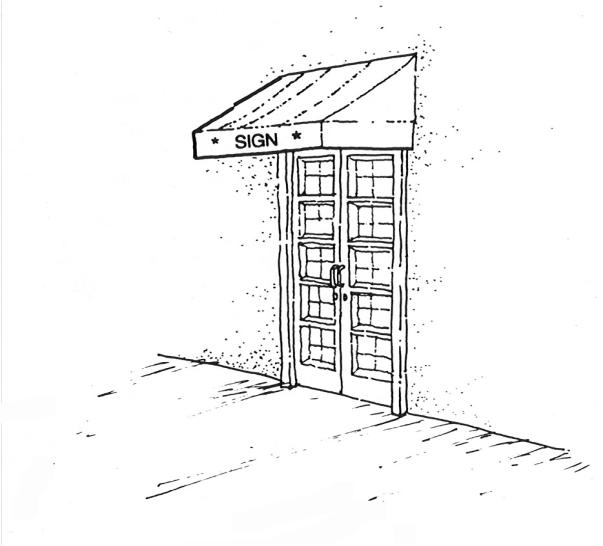
Figure 4 – Ground Sign
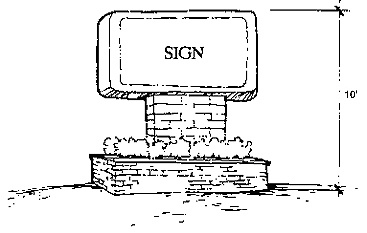

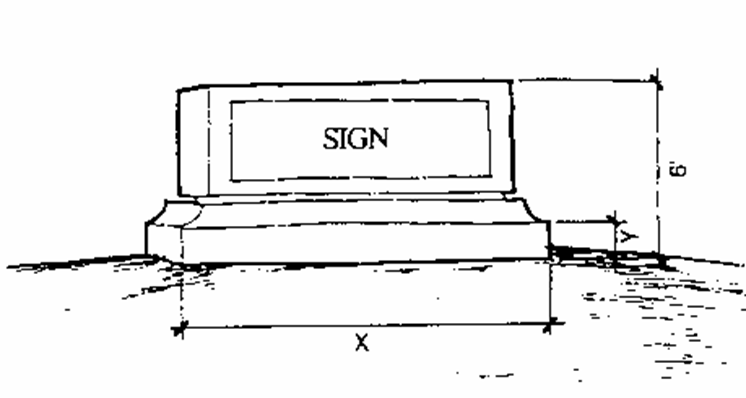
Figure 5 – Monument Sign

(Ord. 2138; Ord. 2324)
Figure 6 – Elevated Sign
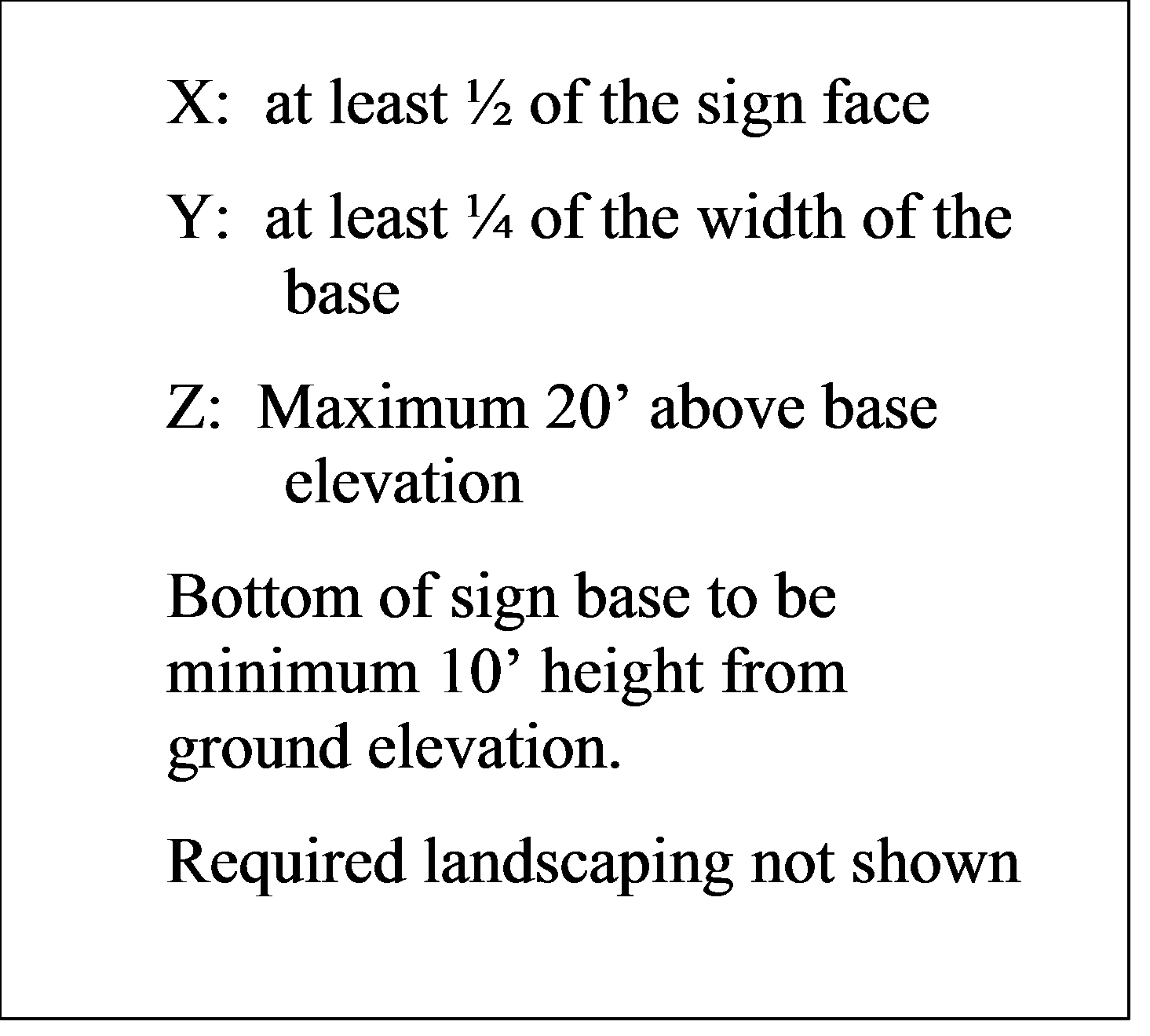
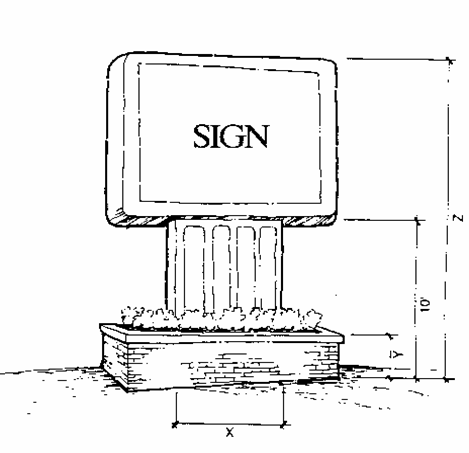
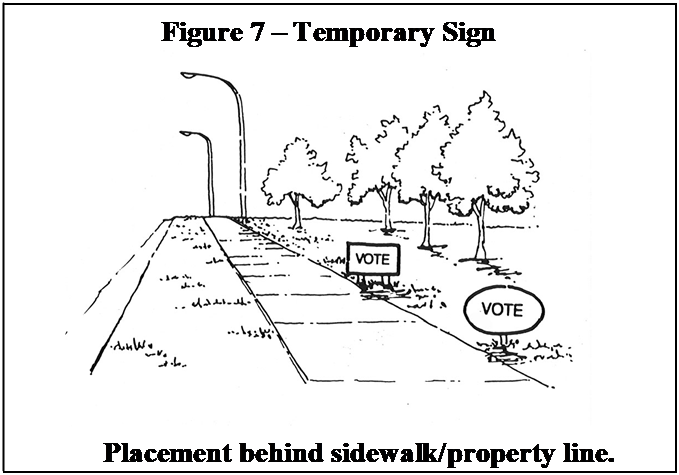
Figure 8 – Projecting Sign
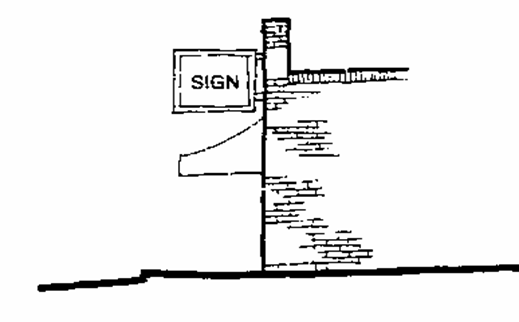
Figure 9 – Wall Sign
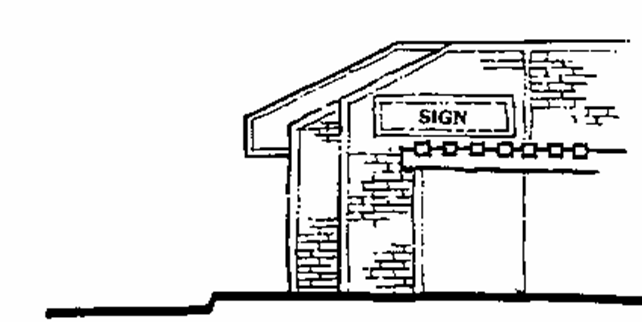
Figure 10 – Window Sign
(Ord. 2138; Ord. 2399)
5. General Standards.
Unless otherwise provided by these regulations, the following general standards shall apply to all signs. (Ord. 2213)
A. Sign Face Area:
1. The area of the sign face shall include the entire area within a single continuous perimeter enclosing the extreme limits of the sign, exclusive of the base or structure on which it is mounted or from which it is suspended. If more than one side of a sign is utilized as a sign, then only the largest side shall be computed and shall be counted as a portion of the gross area. On lots/tracts where more than one sign is located, the total area of all sign faces shall not exceed the maximum area for one sign face permitted by this regulation.
For computing the gross area or sign face of any wall sign which consists of a message directly mounted or painted on a wall, the area shall be deemed to be the area of the smallest rectangular figure which can encompass all of the letters, symbols, logo and/or artwork in the message.
(Ord. 2213; Ord. 2324)
B. Sign Height: Sign height shall be measured from the ground elevation at the base of the sign to the highest element of the sign.
C. Illuminated Signs: A sign designed to give forth artificial light or designed to reflect light derived from any source. Internally illuminated signs or indirectly illuminated signs using a shielded light source shall be permitted. Any lighting fixture on a sign that is located within 10 feet of a property line of a residential zoning district or existing residential use, or within 10 feet of a public right-of-way shall be: (Ord 2138, 2213)
D. Flashing or Moving Signs: Any illuminated sign on which the artificial light is not constant in intensity and color at all times. For the purpose of this regulation, any sign that is revolving, rotating, moving, animated, has moving lights or creates the illusion of movement shall be considered a flashing sign.
E. Other Advertising Displays: The use of hot air balloons or other large inflatable objects, searchlights, rows of pennants or flags, vehicles or trailers used primarily to convey information and secondarily for transportation, ‘air dancers’ or similar vinyl tubes with blower systems, or other, similar displays may be permitted with a Temporary Use Permit (see Article 5 Supplementary District Regulations, Section 9 Temporary Uses). (Ord. 2138)
F. Accessway: No sign shall block any required accessway. (Ord. 2138)
G. Signs on Trees or Utility Poles: No sign shall be attached to any utility pole or tree.
H. Traffic Safety:
(a) Signs projecting over the sidewalk in the “C-1” Central Business District may be allowed. Where signs project more than 12 inches from a structure, a minimum sign height of eight (8) feet above the sidewalk shall be required. In no case shall a sign project over the sidewalk so as to cause potential injury to pedestrians. (Ord. 1182)
(b) In an instance where more right-of-way exists than required by the Subdivision Regulations and/or the Comprehensive Plan, the Planning Commission may allow signs by exception in the right-of-way. In no case shall any sign be placed closer than the minimum “required” right-of-way. In no case shall a sign be located so as to interfere with public infrastructure or other public improvements. (Ord. 1182)
The City maintains the right to remove or relocate any sign within the right-of-way as may be necessary to maintain, improve or expand infrastructure and other public improvements within the existing right-of-way. Removal, relocation or other necessary action shall be at the expense of the developer, property owner, building owner and/or association responsible for the sign or to which the sign is associated. (Ord. 1182)
I. Linear Street Frontage: In those districts where gross sign area is allocated based on linear street frontage and the lot or tract is adjacent to more than one street, the linear street frontage shall be computed as follows:
J. Landscaping: Ground signs, monument signs and elevated signs shall be landscaped as approved on the Master Signage Plan. The landscaped area shall be located around the base of the sign equal to 2.5 square feet for each square foot of graphic display. The landscaped area shall contain landscape material consisting of shrubs, perennial ground cover plants, or a combination of both, placed throughout the required landscape area. (Ord. 2138)
K. Design, Materials and Scale: Signage design shall be incorporated into the overall design of the building(s) and landscaping. The use of unusual shapes, colors, and other characteristics that cause signs to call excessive attention to themselves and create disharmony shall not be allowed. Signs shall not consist predominately of fluorescent colors. Signs shall be constructed of durable materials as determined by the City Building Official. Materials including, but not limited to, plywood, particle board and non-treated lumber are prohibited for permanent signs. Ground, monument and elevated sign bases shall be constructed with stone, concrete, metal, brick or other materials consistent with the building the sign is representing. Signage shall be in keeping with the scale of the building it is representing, as seen in Figure 11 Sign Pattern and Figure 12 sign Scale and Character. (Ord. 2138)
Figure 11 - Sign Pattern
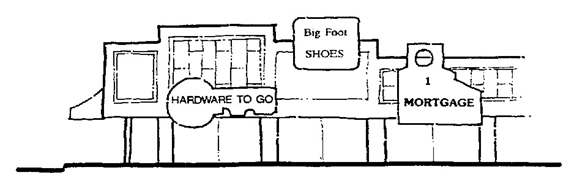
• Inconsistent sign patterns create confusion.
• Signs within or above roof area are prohibited.
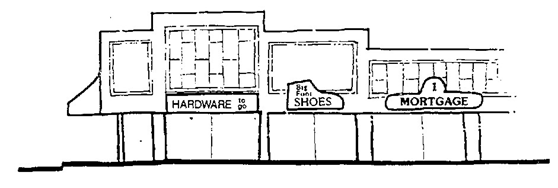
• Employ a consistent sign pattern.
Figure 12 - Sign Scale and Character
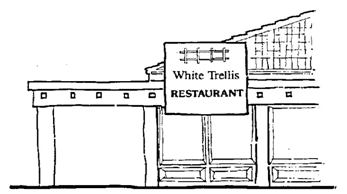
Sign is out of scale and character with building
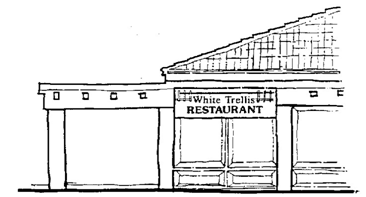
Sign is in scale and character with building
L. Drive-Through Restaurants and Car Washes: Establishments may have 2 signs located in conjunction with each drive-through lane. Such sign shall not exceed 8 feet in height or 32 square feet of surface area per face. All signs shall be oriented toward the location of the vehicle being served and shall not contain lettering that exceeds 6 inches in height. (Ord. 2138)
M. Automated Teller Machines: Up to 3 signs are permitted on the ATM machine, ATM enclosure, or the canopy over the ATM machine. No more than one (1) sign per machine, enclosure or canopy is permitted. Such signs shall not exceed 8 square feet in surface area. (Ord. 2138)
N. Gasoline Signs: A retail establishment dispensing gasoline shall be permitted one (1) double faced sign which shall not exceed 18 square feet of surface area per face.
(Ord. 2138; Ord. 2399)
6. Exemptions.
A. Limited Exemptions: The following signs shall be exempt from the requirements of this article, except for the provisions of Section 5 General Standards, subsections (A) through (H) above: (Ord. 2213)
B. Temporary Signs Exemptions and Standards. Temporary Signs that meet the following standards are exempt from the permit requirements of the sign regulations. Temporary Signs may be posted on private property in all zones of the City any day of the week. In the event of a conflict between a state statute regulating signs (that the City has not chartered out of), and the City sign regulations stated herein, the state statute shall govern. (K.S.A. 25-2711 states the following: No city or county shall regulate or prohibit the placement of or the number of political signs on private property or the unpaved right-of-way for city streets or county roads on private property during the 45-day period prior to any election and the two-day period following any such election. Cities and counties may regulate the size and a set-back distance for the placement of signs so as not to impede sight lines or sight distance for safety reasons.)
(a) Temporary window signs not exceeding 25% of the window surface.
(b) Temporary banner signs shall not exceed 20 square feet in gross area. (Ord. 2206)
(a) Temporary Signs shall be allowed within the road right-of-way each week starting on Thursday and ending on the Sunday immediately following, providing that they conform to the traffic safety requirements found in Article 7 Section 5, Paragraph H of these regulations.
(b) Banner signs may be displayed for a cumulative total of 90 days per year, but no more than twenty-one (21) consecutive days at a time. A period of seven (7) days must elapse between the displays of signs. An annual sign permit is required for the display of banner signs.
(a) The person who has posted or directed the posting of a Temporary Sign is responsible for the removal or replacement of that sign in accordance with these regulations.
(b) If that person does not remove or replace the Temporary Sign in accordance with these regulations, then the property owner or occupant of the lot or tract where the sign is posted is responsible for the sign’s removal or replacement.
(c) The City Administrator, or the City Administrator’s designee, is authorized to remove any Temporary Signs posted in violation of these regulations that are not removed or replaced in accordance with the provisions above. Temporary Signs posted on private property in violation of these regulations shall be deemed a public nuisance, and the City Administrator, or the City Administrator’s designee, may abate the nuisance in accordance with the nuisance abatement and abatement cost recovery procedures contained in the City Code.
(d) The City Administrator, or the City Administrator’s designee, may immediately remove Temporary Signs posted on public property or rights-of-way in violation of these regulations and file a civil complaint against the person who posted the sign to recover the cost of removing the sign.
(Ord. 2349; Ord. 2399)
7. Prohibited Signs.
A. Signs on Public Property: Any sign installed or placed on public property, except in conformance with the requirements set forth herein, shall be forfeited to the public and subject to confiscation. In addition to other remedies hereunder, the City shall have the right to recover from the owner or person placing such a sign the full costs of removal and disposal of such sign.
B. Obscenity: No person shall display upon any sign or other advertising structure any obscene material or message. In accordance with K.S.A. 21-4301, any material is ‘obscene’ if the average person applying contemporary community standards would find that such material, taken as a whole, appeals to the prurient interest; that the material has patently offensive representations or descriptions of ultimate sexual acts, normal or perverted, and that the material, taken as a whole, lacks serious literary, educational, artistic, political or scientific value.
C. Snipe Signs or Portable Display Signs, with or without wheels attached. (Ord. 2138)
D. Flashing Signs as defined by these regulations. (Ord. 2138)
G. Roof Signs. (Ord. 2138)
H. Nonconforming signs abandoned for six months or more, effective January 1, 2007.
(Ord. 2138; Ord. 2399)
8. Maintenance.
A. Existing Sign Maintenance: All signs shall be designed, constructed, and maintained in compliance with applicable provisions of the Building Code and the Electrical Code of the City. Except for banners, flags, temporary signs, and window signs conforming in all respects with the requirements of this regulation, all signs shall be constructed of permanent materials and shall be permanently attached to the ground or another structure by direct attachment to a rigid wall, frame, or structure.
B. Removal of Unsafe or Illegal Signs: If the Codes Enforcement Officer or his/her designee shall find that any sign or other advertising structure regulated herein is unsafe or insecure, or is a menace to the public, or has been constructed or erected or is being maintained in violation of the provisions of this regulation, it shall give written notice to the permittee thereof. If the permittee fails to remove or alter the structure so as to comply with the standards herein set forth within ten days after such notice, such sign or other advertising structure may be removed or altered to comply by the Codes Enforcement Officer or his/her designee at the expense of the permittee or owner of the property upon which it is located. The Codes Enforcement Officer or his/her designee shall refuse to approve a permit to any permittee or owner who refuses to pay costs so assessed. The Codes Enforcement Officer or his/her designee may cause any sign or other advertising structure that is an immediate peril to persons or property to be removed summarily and without notice. (Ord. 2138)
C. Sign Maintenance Enforcement:
D. Painted Sign Maintenance: The owner of any sign as defined and regulated by this regulation shall be required to have properly painted at least once every two (2) years all parts and supports of the sign, unless the same are galvanized, powder coated or otherwise treated to prevent rust.
(Ord. 2138; Ord. 2399)
9. Nonconforming Signs.
For the purpose of this section, a nonconforming sign shall be defined as a sign legally existing at the effective date of this regulation which could not be built under the terms of this regulation or under the terms of other City regulations. Nonconforming signs must be maintained in good condition, including replacement or repair of worn or damaged parts of the sign or its supporting structure. A change in the message or content of signage is not considered an alteration for the purposes of this section. Signs that are nonconforming, as provided in this regulation, shall not be enlarged or moved unless made to comply with the provisions of this regulation. No alteration of nonconforming signs shall be undertaken without the issuance of a permit. No fee will be charged for the permit, provided the alterations do not substantially alter the basic design or concept of the sign.
(Ord. 2138; Ord. 2323; Ord. 2399)
10. Removal of Nonconforming Signs.
Should any nonconforming sign be damaged by any means to an extent of more than 50 percent of its replacement cost at the time of damage, it shall not be reconstructed except in conformity with the provisions of these regulations.
A. Removal of Signs upon Destruction of Principal Structures: When a principal structure is destroyed or removed due to natural or man-made circumstances, all signs on the property shall be removed within 90 days, unless a building permit has been issued within said time period to replace the structure.
B. Amortization and Removal of Off-Site Nonconforming Signs: All off-site nonconforming signs in the public right-of-way prohibited by the provisions of these regulations shall be removed on or before January 1, 2007.
C. Abandoned signs for businesses that have relocated or closed shall have the sign or signs removed, covered or replaced with a blank within 90 days of relocation or closure.
D. Pole signs described in Exhibit A of Ordinance 2323, dated December 20, 2012, that are damaged or destroyed by a catastrophic event, may be replaced or rebuilt in the same location. Said sign shall be no taller, and the sign face shall be no larger than the sign it is replacing. Replacement of a pole sign shall not be undertaken without the issuance of a sign permit.
(Ord. 2138; Ord. 2323; Ord. 2399)
11. Office Parks, Shopping Centers and Planned Districts.
A. For purposes of this section the terms “shopping center, office park, or their groupings,” shall mean a project of one or more buildings that has been planned as an integrated unit or cluster of units on property under unified control or ownership. The sale, subdivision, or other partition of the site does not exempt the project or portions thereof from complying with these regulations. (Ord. 2213)
B. Master Signage Plan. In the case of a proposed office park, shopping center, or other grouping of three or more tenants or establishments (new or remodeled), the developer shall prepare and submit to the Planning Commission a Master Signage Plan for all permanent exterior signs. Such Plan shall set standards that shall run with all leases or sales of portions of the development. Final Development Plans shall not be approved until the Planning Commission has approved the sign standards. (Ord. 2213)
C. In the case of a “shopping center, office park or other grouping” which is occupied by more than two tenants, one monument sign or ground sign may be permitted in addition to the wall mounted signs, which sign shall depict only the name of the center or grouping of shops or offices.
D. Where all tenants and/or property owners within a building or “shopping center, office park or other grouping” agree in writing, one tenant may, in lieu of the wall sign permitted, have one monument sign or ground sign. The design and location of this sign shall be subject to approval of the Planning Commission.
E. Signs shall be similar to the architectural style and coloring scheme of the building(s) and with each other in order to present a consistent image.
(Ord. 2138; Ord. 2399)
12. District Regulations: (Ord. 22348).
A. “R-A Rural Agriculture, “R-0” Residential Suburban, “R-1” Residential - Low Density, “R-1A” Residential – Medium Density Single-Family, “R-2” Residential - Medium Density, “R-2A” Residential – High Density District, “R-3” Multifamily Dwelling, “R-H” Residential–Historic “Old Town” District: (Ord. 2199, 2237, 2397)
(a) Ground signs.
(b) Monument signs
(c) Temporary signs
(d) Wall signs.
(a) Ground and monument signs: fifty (50) square feet
(b) Temporary signs per Section 6 Exemptions, subsection b Temporary Signs Exemptions and Standards
(c) Wall signs: twenty-five (25) square feet.
(a) Ground signs maximum ten (10) feet
(b) Monument signs maximum six (6) feet
(c) Wall signs may extend to the roof eave line
B. “C-1” Business-Central Districts and “O-I” Office-Institutional Districts:
(a) Awning, canopy or marquee signs.
(b) Ground signs.
(c) Monument signs.
(d) Projecting signs.
(e) Temporary signs per Section 6 Exemptions, subsection b Temporary Signs Exemptions and Standards
(f) Wall signs.
(g) Window signs
(h) Pole signs regulated separately, per Special Use Permit.
(i) Electronic Variable Message Boards regulated separately, per Special Use Permit
(a) Awning, canopy or marquee signs and wall signs: One per tenant.
(b) Ground, monument, or projecting signs: One per lot or tract.
(a) Awning, canopy, marquee: one (1) square foot for each linear foot of awning, canopy or marquee width.
(b) Ground and monument signs: one (1) square foot for each lineal foot of street frontage, provided no single sign shall exceed a gross surface area of fifty (50) square feet. On lots/tracts with multiple street frontages, the street frontage calculation is not cumulative; it is based only upon the street the sign is placed.
(c) Wall signs: one (1) square foot for each linear foot of front building wall but not more than 25% of the wall area on which the sign is placed.
(d) Projecting signs: twelve (12) square feet
(e) Window sign: 25% of window area
(a) Awning, canopy, marquee signs: no projection above, below or beyond awning canopy or marquee area.
(b) Ground signs maximum ten (10) feet
(c) Monument maximum six (6) feet
(d) Wall and projecting signs may project to the roof eave line; the bottom edge of a projecting sign must be at least eight (8) feet above the grade of an accessway or sidewalk.
C. “C-2” Business-General Districts and “M-1” Light Industrial Districts:
(a) Awning, canopy or marquee signs.
(b) Elevated signs, subject to conditions at Subsection C (8).
(c) Ground signs.
(d) Monument signs.
(e) Projecting signs.
(f) Temporary signs per Section 6 Exemptions, Subsection b Temporary Signs Exemptions and Standards
(g) Wall signs.
(h) Window signs
(i) Pole signs regulated separately, per Special Use Permit.
(j) Electronic Variable Message Boards regulated separately, per Special Use Permit.
(a) Awning, canopy or marquee, projecting or wall signs: Five per principal structure, or one per tenant. No awning, canopy, marquee, projecting, or wall signs shall be allowed on any accessory structure.
(b) Ground, monument or elevated signs: One per lot or tract.
(a) Awning, canopy, marquee: one (1) square foot for each linear foot of awning, canopy or marquee width.
(b) Ground and monument signs: two (2) square feet for each linear foot of street frontage. On lots/tracts with multiple street frontages, the street frontage is not cumulative.
(c) Projecting signs: twelve (12) square feet
(d) Wall signs: Total area of all wall signs on any building façade shall not exceed 10% of the wall area of the façade upon which they are placed.
(e) Window sign: 25% of window area.
(a) Awning, canopy, marquee signs: no projection above, below or beyond awning canopy or marquee area.
(b) Elevated signs may not exceed the height as provided for in subsection C (8).
(c) Ground signs maximum ten (10) feet
(d) Monument maximum six (6) feet
(e) Wall and projecting signs may extend to roof eave line; the bottom edge of a projecting sign must be at least eight (8) feet above the grade of an accessway or sidewalk.
(a) The height of elevated signs shall be no greater than twenty (20) feet above the base elevation.
(b) The gross surface area of the face of the sign shall not exceed 100 square feet.
(Ord. 2138; Ord. 2324)
D. “M-2” Heavy Industrial Districts: (Ord. 2213)
(a) Awning, canopy and marquee signs: no projection above, below or beyond awning canopy or marquee area.
(b) Ground signs: ten (10) feet
(c) Monument signs: six (6) feet
(d) Wall and projecting signs may extend to the roof eave line; the bottom edge of a projecting sign must be at least 8 feet above the grade of an accessway or sidewalk.
(e) Elevated signs: twenty (20) feet.
(Ord. 2138; Ord. 2213; Ord. 2324; Ord. 2338; Ord. 2348; Ord. 2349; Ord. 2397; Ord. 2399)