As used in this article, the words and phrases herein defined shall have the following meanings unless the context otherwise requires:
(a) Whenever the word municipality is used in the building code, it shall be held to mean the City of De Soto, Kansas;
(b) Whenever the term corporation counsel is used in the building code, it shall be held to mean the city attorney of the City of De Soto;
(c) Whenever the term building official is used in the building code, it shall be held to mean the building inspector or his or her authorized designee.
(Ord. 820, Sec. 2; Code 1998)
4-202. Adoption of International Building Code, the International Existing Building Code, the International Property Maintenance Code, the International Mechanical Code, the International Plumbing Code, the International Fuel Code, the International Swimming Pool and Spa Code, the Energy Conservation Code, the International Solar Energy Provisions, and the Standard for Accessible and Usable Buildings and Facilities.
(a) There is hereby adopted and incorporated by reference, for the purpose of establishing rules and regulations for the construction, alteration, removal, demolition, equipment, use and occupancy, location and maintenance of buildings and structures, swimming pools and spas, and plumbing and mechanical equipment, the International Building Code, 2018 Edition, the International Existing Building Code, 2018 Edition, the International Property Maintenance Code, 2018 Edition, the International Mechanical Code, 2018 Edition, the International Plumbing Code, 2018 Edition, the International Fuel Code, 2018 Edition, the International Swimming Pool and Spa Code, 2018 Edition, the Energy Conservation Code, 2018 Edition, the International Solar Energy Provisions, 2018 Edition, and the “ICC A117.1-2017” Standard for Accessible and Usable Buildings and Facilities, all as recommended by the International Conference of Building Officials, such codes being made a part of the ordinances and code of the city as if the same had been set out in full herein, all as authorized and in the manner prescribed by K.S.A. 12-3009 through 12-3012 including any amendments thereto. At least one copy of each Code referenced herein shall be marked or stamped “Official Copy as Incorporated by the Code of the City of De Soto,” and shall be available from the city clerk to be open to inspection and available to the public at all reasonable hours of business.
(b) In the event an application for a building permit is submitted to the City Building Inspector no later than 120 days after a required final planning commission approval (e.g. final plat, site plan, etc.), and such finally approved plat or plan was based on architectural or construction drawings or plans prepared in accordance with the City’s building code regulations in effect at the time of the final approval, the City Building Inspector has the discretion to apply the building codes (or any part thereof) that were in effect at the time of the final planning commission approval, instead of the newly adopted building codes (or any part thereof).
(Ord. 2184; Code 2009; Ord. 2318-A; Ord. 2451; Ord. 2456; Ord. 2689)
(a) There is hereby adopted and incorporated by reference, for the purpose of establishing rules and regulations for the construction, alteration, removal, demolition, equipment, use and occupancy, location and maintenance of residential buildings and structures, the International Residential Code, 2018 Edition, as recommended by the International Conference of Building Officials, such code being made a part of the ordinances and code of the city as if the same had been set out in full herein, all as authorized and in the manner prescribed by K.S.A. 12-3009 through 12-3012 including any amendments thereto. At least one copy of the International Residential Code, 2018 Edition, referenced herein shall be marked or stamped “Official Copy as Incorporated by the Code of the City of De Soto,” and shall be available from the city clerk to be open to inspection and available to the public at all reasonable hours of business.
(b) In the event an application for a building permit is submitted to the City Building Inspector no later than 120 days after a required final planning commission approval (e.g. final plat, site plan, etc.), and such finally approved plat or plan was based on architectural or construction drawings or plans prepared in accordance with the City’s building code regulations in effect at the time of the final approval, the City Building Inspector has the discretion to apply the building codes (or any part thereof) that were in effect at the time of the final planning commission approval, instead of the newly adopted building codes (or any part thereof).
(Ord. 2689)
The following sections of this article are in addition to, or are revisions of, the standard codes incorporated by reference in sections 4-202 and 4-203 of Article 2 of Chapter 4 of the City Code:
(a) Adoption of Street, Storm Sewer and Sidewalk Construction Standards. There is hereby adopted by reference the street, storm sewer and sidewalk construction standards of the latest publication by the Kansas City Metropolitan Chapter of the American Public Works Association.
|
Building Code |
(b) 101.4.1 Referenced codes. The other codes listed in Sections 101.4.1 through 101.4.7 and referenced elsewhere in this code, specifically the 2018 Editions of the International Building Code, the International Existing Building Code, the International Residential Code, the International Property Maintenance Code, the International Mechanical Code, the International Plumbing Code, the International Fuel Code, the International Swimming Pool and Spa Code, the International Solar Energy Provisions, and the Energy Conservation Code, and the “ICC A117.1-2017” Standard for Accessible and Usable Buildings and Facilities, and 2017 National Electric Code, shall be considered part of the requirements of this code.
(c) 105.1.3 Contractor’s License. All persons undertaking work which requires a permit as provided in section 105, or seeking to obtain said permit from the City, must comply with the Johnson County, Kansas Contractor’s License program.
(d) 105.2 Work exempt from permit.
Building:
1. One-story detached accessory structures used as tool and storage sheds, playhouses and similar uses, provided the floor area is not greater than 200 square feet.
2. This subsection (2) related to fences is deleted.
14. Re-siding the dwelling or structure with materials other than stucco or EIFS.
(e) 110.3.8.1 Other Inspections. Whenever gas service is disconnected or shut off to a structure for a period of six (6) months or more, a gas pressure test will be required before the gas service may be restored by the utility.
(f) 202 Definitions. The term “approved certified sprinkler system” shall mean one that has been designed by an engineer who is licensed in the State of Kansas, and installed by a contractor licensed to do so by the Johnson County Contractor Licensing Program, and approved by the City Building Code Official.
(g) 308.5.5 Daycare being provided in a dwelling unit in compliance with K.S.A. 31-133. A facility within a dwelling unit that is providing custodial care in compliance with K.S.A 31-133 shall be classified as a Group R-3 occupancy or shall comply with the International Residential Code for One and Two-Family Dwellings as adopted by the City.
(h) [F] 903.4.1 Monitoring. Alarm, water-flow, supervisory and trouble signals shall be distinctly different and shall be automatically transmitted to an approved UL-listed central station as defined in NFPA 72, or, when approved by the fire code official, shall sound an audible signal at a constantly attended location. The fire alarm system installed to transmit such signals shall be considered a building fire alarm system and shall be documented as a UL-certified central station service system.
Exceptions:
1. Underground key or hub valves in roadway boxes provided by the municipality or public utility are not required to be monitored.
2. Backflow prevention device test valves located in limited area sprinkler system supply piping shall be locked in the open position. In occupancies required to be equipped with a fire alarm system, the backflow preventer valves shall be electronically supervised by a tamper switch installed in accordance with NFPA 72 and separately annunciated.
(i) [F] 903.4.2 Alarms. One exterior audible/visual device shall be connected to every automatic sprinkler system in an approved location. Such sprinkler water-flow devices shall be activated by water flow equivalent to the flow of a single sprinkler of the smallest orifice size installed in the system. Where a building fire alarm system is installed, actuation of the automatic sprinkler system shall actuate the building fire alarm system. Interior alarm notification appliances shall be installed as required by Section 903.4.2.1.
(j) [F] 903.4.2.1 Notification devices. Where an automatic fire sprinkler system is installed in a building, audible and visible notification appliances shall be installed throughout the building as follows:
1. Audible notification appliances shall be installed so as to be audible at 15 dBa above average sound pressure level throughout the building.
2. Visible notification appliances shall be installed in all public and common use areas, restrooms and corridors in accordance with the spacing requirements of NFPA 72.
3. Visible notification devices can be eliminated in normally unoccupied portions of the buildings where permitted by the fire code official.
(k) [F] 907.6.5 Monitoring. Fire alarm systems required by this Section or by the International Building Code shall be monitored by an approved supervising station in accordance with NFPA 72. An Underwriters Laboratories (UL) Fire Alarm certificate shall be issued by the UL listed fire alarm contractor for all newly installed fire alarm systems or existing fire alarm systems included in an existing building involved in any construction project involving a building permit.
Exceptions: Monitoring by a supervising station is not required for:
1. Single- and multiple-station smoke alarms required by Section 907.2.11.
2. Smoke detectors in Group I-3 occupancies.
3. Automatic sprinkler systems in one and two story dwellings.
(l) [F] 907.7.4 Contractor’s Statement. A contractor’s statement verifying that the system has been installed in accordance with the approved plans and specifications and has been 100% tested in accordance with NFPA 72. The statement will also include that all personnel involved with the installation of the fire alarm system meet the qualification requirements of the fire code official.
(m) [F] 912.3.4 Fire department connections. The connection shall be a four-inch (4”) Storz quick coupling connector with cap.
(n) 1805.2.1.1 Frost Protection. Extending below the frost line of the locality, which, for De Soto, Kansas, is 36 inches in depth.
|
Residential Code |
(o) Amend Section 101.1 to read “These provisions and all deletions, changes, and additions shall be known as the Residential Code for One- and Two-Family Dwellings of De Soto, KS, and shall be cited as such and will be referred to herein as “this code.””
(p) Amend Section 101.1 to read “These provisions and all deletions, changes, and additions shall be known as the Residential Code for One- and Two-Family Dwellings of De Soto, KS, and shall be cited as such and will be referred to herein as “this code.””
(q) Add Section R102.5.1 Appendices E, F, H, and I are adopted.
(r) Delete Section 103.2
(s) Amend Section R105.2 Work exempt from permit.
Building:
1. One-story detached accessory structures used as tool and storage sheds, playhouses and similar uses, provided the floor area is not greater than 200 square feet.
2. This subsection (2) related to fences is deleted.
5. Sidewalks and driveways not installed in the public right of way.
(t) Amend Section R106.1 to read “Submittal documents consisting of construction documents, and other data shall be submitted in two or more sets, or in digital form where allowed by the building official, with each application for a permit. The construction documents shall be prepared by a registered design professional, as required by the building official. Where special conditions exist, the building official is authorized to require additional construction documents to be prepared by a registered design professional.
(u) Amend Section R106.3.1 to read “Where the building official issues a permit, the construction documents shall be approved in writing or by a stamp that reads “REVIEWED FOR CODE COMPLIANCE.” One set of construction documents so reviewed shall be retained by the building official. The other set shall be returned to the applicant, shall be kept at the site of work and shall be open to inspection by the building official or a duly authorized representative. Access to digital form construction documents shall be acceptable in lieu of physical copy on site.”
(v) Amend Section R108.3 to read “Building permit valuation shall include total value of the work for which a permit is being issued, such as electrical, gas, mechanical, plumbing equipment and other permanent systems, including labor and materials. Building permit valuation shall be determined by using the most current ICC Building Valuation Data table or declared value by applicant, whichever is higher.”
(w) Add Section R109.1.2.1 Gas Test Required Whenever gas service is disconnected or shut off to a dwelling unit for a period of six (6) months or more, a gas pressure test shall be required before the gas service may be restored by the utility.
(x) Add Section R109.5 Erosion and Sediment Control If the required erosion and sediment control measures are not in place and operational as required by KDHE guidelines and the City of De Soto Single Family Residential Construction Erosion and Sediment Control Standards, all inspections related to the permitted site from that date forward will not be conducted until the erosion and sediment control measures have been reinstated and inspected.
(y) Amend Table 301.2(1) to include area specific values below.
Ground Snow Load – 20 psf
Speed (mph) – 115 mph
Topographic Effects – NO
Special Wind Region – NO
Windborne Debris Zone – NO
Seismic Design Category – A
Weathering – Severe
Frost Line Depth – 36”
Termite – Moderate to Heavy
Ice Barrier Underlayment Required – YES
Flood Hazards – 08/01/79, 08/03/09
Air Freezing Index – 1000
Mean Annual Temp – 54.8
(z) Delete Section R302.3 and R302.3.1 and replace with new R302.3 to read “Dwelling units in two-family dwellings shall be separated from each other in accordance with the requirements of townhouses as set forth in section R302.2”
(aa) Amend Section R302.7 to read “Under-stair surfaces of stairways shall be protected with minimum ½-inch gypsum board. EXCEPTIONS: 1. Exterior Stairways. 2. Stairways of noncombustible materials. 3. Decorative and open stairways where approved by the building official.”
(bb) Amend Section R303.4 to read “Where the air infiltration rate of a dwelling unit is less than 3 air changes per hour when tested with a blower door at a pressure of 0.2 inch w.c (50 Pa) in accordance with Section N1102.4.1.2, the dwelling unit shall be provided with whole-house mechanical ventilation in accordance with Section M1505.4.”
(cc) Add Section R306.5 New single family dwellings toilet facilities Toilet facilities shall be provided within 500 feet (measured from the property line adjacent to the street for platted subdivisions along the public way) for all new single family dwellings starting from the time of the first footing inspection until facilities are available in the dwelling. If the facilities are not located on the job site, the location of the required facilities shall be posted on the job site or other certification provided to the Building Code Official to verify the availability of toilet facilities, should the building official approve. The facilities on the site shall be removed prior to issuance of a Temporary Certificate of Occupancy.
(dd) Add Section R306.6 New single family dwellings construction site maintenance All construction sites shall be maintained in a good, clean, and safe condition, including, but not limited to, the following minimum requirements:
1. Construction materials shall be stored, maintained and secured so as to prevent safety risk or danger. Accumulated construction debris shall be hauled away and disposed of at an approved land fill. Dumpsters shall be emptied or removed when full and may be used only for construction debris. Construction materials shall not be stored in a public right-a-way.
2. All mud, dirt, or debris deposited on any street, crosswalk, sidewalk, or other public property as a result of excavation, construction, or demolition shall be immediately broom cleaned to the extent possible and disposed of in an acceptable manner.
3. It shall be unlawful to intentionally place, deposit, or otherwise dispose of construction debris in any public or private sewer.
4. Airborne particles shall be controlled on the property at all times during work by means of a water truck and/or spraying equipment, or other water sources capable of spraying and thoroughly saturating all portions of the structure and surrounding property affected by the work. Spraying shall be undertaken at all times necessary to thoroughly control the creation and migration of airborne particles, including, without limitation, dust, from the subject property.
5. No person shall operate or cause to be operated any radio, media player, telecommunications device or other such object at such a volume or in any other manner that would cause a nuisance or disturbance to any person.
6. Every contractor shall be responsible for all actions of their employees, agents, and subcontractors under this subsection, and shall be responsible for all violations of the provisions of this subsection committed by such employees, agents, or subcontractors.
(ee) Delete Section R309.5 Fire Sprinklers.
(ff) Amend Section R313.1 to read “An automatic sprinkler system may be installed in townhouses.”
(gg) Amend Section R313.2 to read” An automatic sprinkler system may be installed in one- and two-family dwellings.”
(hh) Amend Section R314.2.2 to read “Where alterations, repairs or additions requiring a permit occur, the individual dwelling unit shall be equipped with smoke alarms located as required for new dwellings.
Exceptions:
1. Work involving the exterior surfaces of dwellings, such as the replacement of roofing or siding, the addition or replacement of windows or doors, or the addition of a porch or deck.
2. Installation, alteration or repairs of plumbing, mechanical, or electrical service systems.
(ii) Add Section R314.8 Heat Detectors. Any integral or attached garage to the main house shall be provided with a single heat detector. Heat detectors shall be hard wired and interconnected with the household smoke alarm system, such that the activation of the heat detector will activate all of the audible alarms of the required household smoke alarm system. The required heat detector is not required to incorporate audible alarm notification nor is any audible notification device required in the garage. The heat detector shall be listed for the ambient environment and installed per the manufacturer's installation instructions.
EXCEPTIONS:
1. Heat detectors shall not be required with alterations, repairs or additions.
2. Heat detectors shall not be required in detached garages.
(jj) Delete Exception 4 from Section R316.3 to conform with State statute.
(kk) Amend Section R327 to read:
Section R327 Energy
Storage Systems
R327.1 General.
Energy storage systems (ESS) shall comply with the provisions of this section.
Exceptions:
1. ESS listed and labeled for use in habitable spaces, in accordance with UL 9540 and where installed in accordance with the listing, the manufacturer’s instructions and NFPA 70.
2. ESS less than 1 kWh (3.6 megajoules).
R327.2 Equipment listings. Energy storage systems (ESS) shall be listed and labeled in accordance with UL 9540.
Exception: Where approved, repurposed unlisted battery systems from electric vehicles are allowed to be installed outdoors or in detached sheds located not less than 5 feet (1524 mm) from exterior walls, property lines and public ways.
R327.3 Installation. ESS shall be installed in accordance with the manufacturer’s instructions and their listing.
R327.3.1 Spacing. Individual units shall be separated from each other by not less than 3 feet (914 mm) except where other separation distances are specified by the ESS listing and the manufacturer’s installation instructions.
R327.4 Locations. ESS shall be installed only in the following locations:
1. Detached garages and detached accessory structures.
2. Attached garages separated from the dwelling unit living space in accordance with Section R302.6.
3. Outdoors or on the exterior side of exterior walls located not less than 3 feet (914 mm) from doors and windows directly entering the dwelling unit, except where smaller separation distances are permitted by the UL 9540 listing and manufacturer’s installation instructions.
4. Enclosed utility closets, basements, storage or utility spaces within dwelling units with finished or noncombustible walls and ceilings. Walls and ceilings of unfinished wood-framed construction shall be provided with not less than 5/8-inch (15.9 mm) Type X gypsum wallboard. Openings into the dwelling shall be equipped with solid wood doors not less than 1 3/8 inches (35 mm) in thickness, solid or honeycomb-core steel doors not less than 1 3/8 inches (35 mm) in thickness, or doors with a 20-minute fire protection rating. Doors shall be self-latching and equipped with a self-closing or an automatic-closing device. Penetrations through the required gypsum wallboard into the dwelling shall be protected as required by Section R302.11, Item 4.
ESS shall not be installed in sleeping rooms, or closets or spaces opening directly into sleeping rooms.
R327.5 Energy ratings. Individual ESS units shall have a maximum rating of 20 kWh. The aggregate rating of the ESS shall not exceed:
1. 40 kWh within utility closets, basements and storage or utility spaces.
2. 80 kWh in attached or detached garages and detached accessory structures.
3. 80 kWh on exterior walls.
4. 80 kWh outdoors on the ground.
ESS installations exceeding the permitted individual or aggregate ratings shall be installed in accordance with Section 1207 of the International Fire Code.
R327.6 Electrical installation. ESS shall be installed in accordance with NFPA 70. Inverters shall be listed and labeled in accordance with UL 1741 or provided as part of the UL 9540 listing. Systems connected to the utility grid shall use inverters listed for utility interaction.
R327.7 Fire detection. Rooms and areas within dwelling units, basements and attached garages in which ESS are installed shall be protected by smoke alarms in accordance with Section R310. A heat detector, listed and interconnected to the smoke alarms, shall be installed in locations within dwelling units and attached garages where smoke alarms cannot be installed based on their listing.
R327.8 Protection from impact. ESS installed in a location subject to vehicle damage shall be protected in accordance with Section R327.8.1 or R327.8.2.
R327.8.1 Garages. Where an ESS is installed in the normal driving path of vehicle travel within a garage, impact protection complying with Section R330.8.3 shall be provided. The normal driving path is a space between the garage vehicle opening and the interior face of the back wall to a height of 48 inches (1219 mm) above the finished floor. The width of the normal driving path shall be equal to the width of the garage door opening. Impact protection shall also be provided for an ESS installed at either of the following locations (see Figure R330.8.1):
1. On the interior face of the back wall and located within 36 inches (914 mm) to the left or to the right of the normal driving path.
2. On the interior face of a side wall and located within 24 inches (610 mm) from the back wall and 36 inches (914 mm) of the normal driving path.
Exception: Where the clear height of the vehicle garage opening is 7 feet 6 inches (2286 mm) or less, ESS installed not less than 36 inches (914 mm) above finished floor are not subject to vehicle impact protection requirements.
FIGURE R327.8.1 ESS VEHICLE IMPACT
PROTECTION
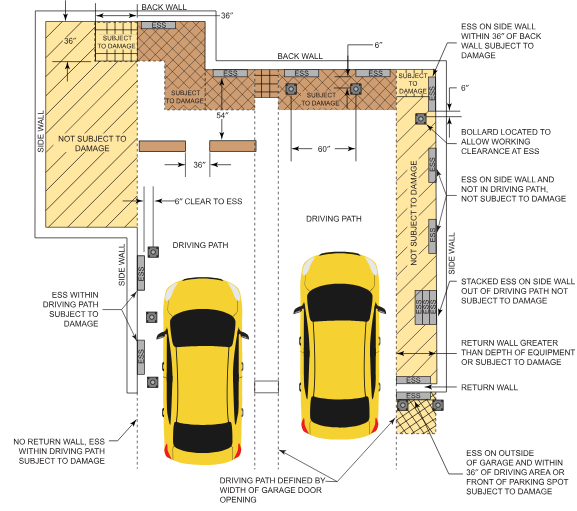
R327.8.2 Other locations subject to vehicle impact. Where an ESS is installed in a location other than as defined in Section R327.8.1 and is subject to vehicle damage, impact protection shall be provided in accordance with Section R327.8.3.
R327.8.3 Impact protection options. ESS protection shall comply with one of the following:
1. Bollards constructed in accordance with one of the following:
1.1. Minimum 48 inches (1219 mm) in length by 3 inches (76 mm) in diameter Schedule 80 steel pipe embedded in a concrete pier not less than 12 inches (305 mm) deep and 6 inches (152 mm) in diameter, with not less than 36 inches (914 mm) of pipe exposed, filled with concrete and spaced at a maximum interval of 5 feet (1524 mm). Each bollard shall be located not less than 6 inches (152 mm) from an ESS.
1.2. Minimum 36 inches (914 mm) in height by 3 inches (76 mm) in diameter Schedule 80 steel pipe fully welded to a steel plate not less than 8 inches (203 mm) in length by 1/4 inch (6.4 mm) in thickness and bolted to a concrete floor by means of 4 1/2-inch (114 mm) concrete anchors imbedded not less than 3 inches (76 mm). Spacing shall be not greater than 60 inches (1524 mm), and each bollard shall be located not less than 6 inches (152 mm) from the ESS.
1.3. Premanufactured steel pipe bollards filled with concrete and anchored in accordance with the manufacturer’s installation instructions, with spacing not greater than 60 inches (1524 mm). Each bollard shall be located not less than 6 inches (152 mm) from the ESS.
2. Wheel barriers constructed in accordance with one of the following:
2.1. Concrete or polymer 4 inches (102 mm) in height by 5 inches (127 mm) in width by 70 inches (1778 mm) in length, anchored to the concrete floor not less than every 36 inches (914 mm) and located not less than 54 inches (1372 mm) from the ESS. Concrete anchors not less than 3 1/2 inches (89 mm) in diameter with 3-inch (76 mm) embedment per barrier shall be used. Spacing between barriers shall be not greater than 36 inches (914 mm).
2.2. Premanufactured wheel barriers shall be anchored in accordance with the manufacturer’s installation instructions.
3. An approved method designed to resist an impact of 2,000 pounds per square foot (95 760 N/m2) in the direction of travel at 24 inches (610 mm) above grade.
R327.9 Ventilation. Indoor installations of ESS that produce hydrogen or other flammable gases during charging shall be provided with mechanical ventilation in accordance with Section M1307.4.
R327.10 Electric vehicle use. The temporary use of an owner or occupant’s electric-powered vehicle to power a dwelling unit while parked in an attached or detached garage or outdoors shall comply with the vehicle manufacturer’s instructions and NFPA 70.
R327.11 Documentation and labeling. The following information shall be provided:
1. A copy of the manufacturer’s installation, operation, maintenance and decommissioning instructions shall be provided to the owner or placed in a conspicuous location near the ESS equipment.
2. A label on the installed system containing the contact information for the qualified maintenance and service providers
(ll) Add Section R401.4.3 Soils report required Foundation designs for new dwellings using the standards referenced in Subsection R404.1.3 shall submit a report from a registered design professional specifying the properties of the soil based on Table 405.1 prior the inspection of footings, if deemed necessary by the Building Code Official.
(mm) Add Section R401.4.4 Johnson County Residential Foundations Guidelines Foundation designs for one-and two-family dwellings may use the approved standards design provided in the Johnson County Residential Foundation Guidelines in lieu of the prescriptive requirements of the 2018 International Residential Code as approved by the Building Code Official.
(nn) Amend Section R402.1 to read “Wood foundation systems are not allowed.”
(oo) Add Section R403.1.1.1 Continuous footing reinforcement. Continuous footing reinforcement. Continuous footings for basement foundation walls shall have minimum reinforcement consisting of not less than two no. 4 bars, uniformly spaced, located a minimum 3 inches (3") clear from the bottom of the footing.
(pp) Add Section R403.1.1.2 Column Pads Column pads shall be a minimum of 24 inches by 24 inches and 8 inches deep (24” x 24” x 8”). Reinforcement shall consist of a minimum of three No. 4 bars each way, uniformly spaced.
(qq) Amend Section R404.1.1 to read “A design in accordance with accepted engineering practice shall be provided for concrete or masonry foundation walls when any of the conditions listed below exist. Where applicable, a standard design approved by the Building Official may be used in lieu of a design from the design professional. For new single-family dwellings where standard designs approved by the city are used, the design professional sealing the plans shall specify the use of those designs on the approved plans or through a separate report.
1. Walls are subject to hydrostatic pressure from ground water.
2. Walls supporting more than 48 inches (48”) of unbalanced backfill that do not have permanent lateral support at the top and bottom.
3. Sites containing CH, MH, OL, or OH soils as identified in Table R405.1
4. Foundation walls exceeding nine feet (9’) in height, measured from the top of the wall to the bottom of the slab.
5. Lots identified on the subdivision grading plan as having more than six feet (6’) of fill or having a finished slope steeper than 4 horizontal to 1 vertical before grading.
6. Footings and foundations with existing fill soils below the footing level.
7. Sloping lots steeper than 4 to 1 before grading.
8. Lots where some footings will bear on soil and others will bear on rock.
9. Areas where problems have historically occurred.
10. Stepped footing and foundation walls.
11. Garage floor slabs supported on more than 24 inches (24”) of clean sand or gravel or eight inches (8”) of earth.”
(rr) Add Section 506.2.5 Basement floor slab isolation. Basement floor slabs shall be isolated from column pads, interior columns and interior bearing walls to facilitate differential movement. Nonbearing walls supported on basement floor slabs shall be provided with a minimum one inch (1”) expansion joint to facilitate differential movement between the floor slab and the floor framing above. Isolation and/or an expansion joint is not required within six inches (6”) of the exterior walls.
(ss) Add Section 807.1.1 Attic Access Latch. Attic access openings located in a garage shall be equipped with latches or a hinge and latch and shall be constructed of minimum ½” thick nominal plywood or other approved material such that the access door is secured closed when not in use.
(tt) Amend Table N1102.1.2 (R402.1.2) to show the following values
|
Climate
Zone |
Fenestration
U-Factorb |
Skylight
U-Factorb |
Glazed
Fenestration SHGCb |
Ceiling
R-Valueg |
Wood
Frame Wall R-Value |
Mass Wall
R-Valuef |
Floor
R-Valuee |
Basement
Wall R-Valuec |
Slab
R-Value & Depthd |
Crawl
Space Wall R-Valuec |
|
4 |
0.32 |
0.55 |
0.40 |
49 |
13 |
8/13 |
19 |
10/13 |
NR |
10/13 |
For SI: 1 foot – 304.8 mm.
NR = Not Required
a. R-values are minimums. U-factors and SHGC are maximums. When insulation is installed in a cavity which is less than the label or design thickness of the insulation, the installed R-value of the insulation shall not be less that the R-value specified in the table.
b. The fenestration U-factor column excludes skylights. The SHGC column applies to all glazed fenestration.
c. “10/13” means R-10 continuous insulation on the interior or exterior of the home or R-13 cavity insulation at the interior of the basement walls.
d. For heated slabs, R-5 insulation shall be provided under the full slab area and shall be added to the slab edge.
e. Or insulation sufficient to fill the framing cavity, R-19 minimum.
f. The second R-value applies when more than half the insulation is on the interior of the mass wall.
g. Loose-fill-insulation shall be installed at the rate recommended by the manufacturer’s statement “so many bags per 1000 sq ft”. Where the pitch of the roof restricts the “minimum thickness” at the exterior wall line, the insulation shall be blown into the cavity so as to achieve a greater compacted density to a point where the “minimum thickness” can be achieved. An alternative is to install high-density batts around the perimeter edge per N1102.2.
(uu) Amend Section N1102.4.1.2 to read “R402.4.1.2 Testing (Mandatory). The building or dwelling unit shall be tested and verified as having an air leakage rate of not exceeding 5 air changes per hour. Testing shall be conducted with a blower door at a pressure of 0.2 inches w.g. (50 Pascals). Where required by the Building Official, testing shall be conducted by an approved third party. A written report of the results of the test shall be signed by the party conducting the test and provided to the Building Official. Testing shall be performed at any time after creation of all penetrations of the building thermal envelope.
During Testing:
1. Exterior windows and doors, fireplaces and stove doors shall be closed, but not sealed, beyond the intended weather stripping or other infiltration control measures;
2. Dampers including exhaust, intake, makeup air, backdraft and flue dampers shall be closed, but not sealed beyond intended infiltration control measures;
3. Interior doors, if installed at the time of the test, shall be open;
4. Exterior doors for continuous ventilation systems and heat recovery ventilators shall be closed and sealed;
5. Heating and cooling systems, if installed at the time of the test shall be turned off; and
6. Supply and return registers, if installed at the time of the test, shall be fully open.”
(vv) Delete Section N1102.4.4 from the code.
(ww) Amend Section N1103.3.3 to remove “(Mandatory)” from the title.
(xx) Amend Section N1106.2 to add an exception “Section R403.5.1 shall not be mandatory for ERI compliance”
(yy) Amend Section N1106.2 to add an exception “Section R403.5.1 shall not be mandatory for ERI compliance”
(zz) Amend Table R1106.4 by deleting the table and replacing with the following table.
|
Climate Zone |
Energy Rating Index a |
|
4 |
80 |
a. Where on-site renewable energy is included for compliance using the ERI analysis of Section N1106.4, the building shall meet the mandatory requirements of Section N1106.2, and the building thermal envelope shall be greater than or equal to the levels of efficiency and SHGC in Table N1102.1.2 or Table N1102.1.4.
(aaa) Amend Section P2603.5.1 to read “Building sewers shall be installed as required by the appropriate Authority Having Jurisdiction.”
(bbb) Add Section E3703.8 Fire Alarm System Permanently installed fire alarm systems, smoke detectors, and carbon monoxide detectors shall be provided with a minimum 15-ampere-rated dedicated branch circuit.
(ccc) Amend Section E3902.2 to add exceptions:
Exceptions:
a. A dedicated ceiling mounted receptacle for a garage door opener.
b. A single receptacle supplied by a dedicated branch circuit that is located and identified for specific use by a cord- and plug-connected appliance such as a refrigerator or freezer.
c. A dedicated receptacle supplying a permanently installed fire alarm or security alarm system.
d. A dedicated receptacle supplying a sump pump.
e. Receptacles installed in accordance with these exceptions shall not be considered as meeting the requirement of Section E3901.9.
(ddd) Amend Section E3902.5 to add exceptions:
Exceptions:
a. A single receptacle supplied by a dedicated branch circuit that is located and identified for specific use by a cord- and plug-connected appliance such as a refrigerator or freezer.
b. A dedicated receptacle supplying a permanently installed fire alarm or security alarm system.
c. A dedicated receptacle supplying a sump pump.
d. Receptacles installed in accordance with these exceptions shall not be considered as meeting the requirement of Section E3901.9.
(eee) Amend Section E3902.16 to change exception language to read “AFCI protection is not required for an individual branch circuit supplying only a permanently installed fire alarm system required by E3907.8.”
|
Plumbing Code |
(fff) 1202.1 Nonflammable medical gases. The following requirement shall be added to this section:
1. On and after January 1, 2011, no person shall install, improve, repair, maintain or inspect a medical gas piping system within a county or city unless such person: (a) is licensed under the provisions of K.S.A. 12-1508 et seq., and amendments thereto; and (b) is certified under the appropriate professional qualifications standard or standards of ASSE Series 6000. All installers shall obtain a proper permit from the county of city for which the medical gas is being installed, all inspections shall be done by a third party agency certified under the appropriate professional qualifications standard or standards of ASSE Series 6000 for medical gas systems inspectors and all documentation of the inspections and certifications of installers and inspectors shall be provided to the county or city prior to any occupancy of the building or unit of the building in which the medical gas piping has been installed until an occupancy permit is issued.
2. As used in this subsection, “medical gas piping” means the piping used solely to transport gasses used for medical purposes at a health care facility.
(ggg) 305.4.1 Sewer Depth. Building sewers that connect to private sewage disposal systems shall be installed not less than 18” below finished grade at the point of septic connection. Building sewers shall be installed not less than 24 inches below grade.
(hhh) 701.3.1 Separate sewer connection. All residential duplex and or condominium units shall have installed separate sanitary sewer service lines to each living unit, from the main line to the living unit.
(iii) Table 702.3 Building sewer pipe. Delete vitrified clay pipe.
(jjj) 708.1.3.1 Building drain and building sewer junction. An approved type clean out fitting shall be installed outside of the building and extended above grade from the waste or soil lines serving a building constructed with concrete floor or with a crawl space foundation.
(kkk) Footnote a. to Table 709.1 Building Drains and Sewers. The minimum size of any building drain serving a water closet shall be four (4) inches.
(lll) 714.1.1 Sewage Backflow. Where the flood level rims of plumbing fixtures are below the elevation of the manhole cover of the next upstream manhole in the public sewer, such fixtures shall be protected by a backwater valve installed in the building drain, branch of the building drain or horizontal branch serving such fixtures. Additionally, backwater valves must be installed at the owner’s expense in residential drains under any of the following circumstances: (1) the residence experiences a sanitary sewer backup that, as determined by the City Building Inspector or Wastewater Superintendent, was directly caused by a backup in the public sewer main; or (2) a new residence is being constructed; or (3) replacements or repairs are being made to an existing residential sanitary sewer lateral line; or (4) a residential remodeling project that exceeds twenty five percent of the residential structure, or (5) more than twenty five percent of the plumbing fixtures in a residential structure are replaced. The plumbing permit fee for installation of a backwater valve at a residence shall be waived by the city.
(mmm) 903.1 Roof extension. All open vent pipes that extend through a roof shall be terminated at least six inches (6”) above the roof, except that where a roof is to be used for any purpose other than weather protection, the vent extensions shall be run at least seven feet (7’) above the roof.
|
Property Maintenance Code |
(nnn) 102.3 Application of other codes. Repairs, additions or alterations to a structure, or changes of occupancy, shall be done in accordance with the procedures and provisions of the 2018 Editions of the International Building Code, the International Existing Building Code, the International Residential Code, the International Property Maintenance Code, the International Mechanical Code, the International Plumbing Code, the International Fuel Code, the International Swimming Pool and Spa Code, the International Solar Energy Provisions, and the Energy Conservation Code, and the “ICC A117.1-2017” Standard for Accessible and Usable Buildings and Facilities, and the 2017 National Electric Code. Where the term ICC Electrical Code is used in other portions of this code, the term shall be used synonymously with the term “NFPA 70 National Electrical Code (NEC), 2017 Edition.”
REFERENCED STANDARDS. Chapter 13 – Referenced Standards of the 2018 International Mechanical Code, shall be amended to read:
NFPA 70-99 – National Electric Code (NEC), 2017 Edition.
(ooo) 103.6 Fees. The fees for activities and services performed by the department in carrying out its responsibilities under this code shall be as indicated in the International Building Code.
(ppp) 304.14 Insect screens. During the period from March 1 to October 31, every door, window and other outside opening required for ventilation of habitable rooms, food preparation areas, food service areas, or any areas where products to be included or utilized in food for human consumption are processed, manufactured, packaged or stored, shall be supplied with approved tightly fitting screens of not less than 16 mesh per inch (16 mesh per 25mm) and every swinging door shall have a self-closing device in good working condition.
(qqq) 602.3 Heat supply. Every owner and operator of any building who rents, leases or lets one or more dwelling unit, rooming unit, dormitory or guestroom on terms, either expressed or implied, to furnish heat to the occupants thereof shall supply heat during the period from October 1 to May 1, to maintain a temperature of not less than 65 degrees F (18 degrees C) in all habitable rooms, bathrooms, and toilet rooms.
Exception: When the outdoor temperature is below the winter outdoor design temperature for the locality, maintenance of the minimum room temperature shall not be required provided that the heating system is operating at its full design capacity. The winter outdoor design temperature for the locality shall be as indicated in Appendix D of the International Plumbing Code.
(rrr) 602.4 Occupiable work spaces. Indoor occupiable work spaces shall be supplied with heat during the period from October 1 to May 1 to maintain a temperature of not less than 65 degrees F (18 degrees C) during the period the spaces are occupied.
Exceptions:
1. Processing, storage and operation areas that require cooling or special temperature conditions.
2. Areas in which persons are primarily engaged in vigorous physical activities.
|
Mechanical Code |
(sss) 102.12 State Boiler Inspector. Where permits are issued and portions of the work require inspection and approval of boilers and pressure vessels by the state of Kansas, those portions of the work will comply with the state requirements in lieu of compliance with the technical provisions of this Code. Contact the State Boiler Inspector at the State Department of Human Resources for complete information regarding state requirements. State approval is generally required for all boilers that require permits.
Exceptions:
1. Boilers serving individual dwelling units and their accessory structures.
2. Boilers serving apartment houses with less than five (5) families.
3. Pressure vessels that do not exceed 15 cubic feet and 250 psi.
|
Energy Conservation Code |
(ttt) R103.2.1 Information on construction documents. When following the Resnet Path, this information will be provided to the rater.
(uuu) Table R402.1.2. Insulation and Fenestration Requirements by component. Amend the table to read:
Table R402.1.2
Insulation and Fenestration Requirements by Componenta
|
Climate |
Fenestration |
Skylight |
Glazed |
Ceilingg |
Wood |
Mass |
Floor |
Basement Wall |
Slabd R-Value |
Crawl Spacec |
|
Zone |
U-factorb |
b U-factor |
Fenestration SHGCb |
R-value |
Frame Wall R-value |
Wall R-Valuef |
R-Value |
R-valuec |
& Depth |
Wall R-Value |
|
4 |
0.32 |
0.55 |
0.40 |
49 |
13/19 |
8/13 |
19 |
10/13 |
NR |
10/13 |
(vvv) R402.4.1.2 Testing. “Five air changers per hour in climate zone 3-8.”
(www) C408 System Commissioning. Delete this section.
(Ord. 755; Ord. 2184, Sec. 2; Code 2009; Ord. 2292; Ord. 2318-A; Ord. 2451; Ord. 2689)
(a) This and other articles of the city relating generally to the enforcement of uniform codes shall be administered and enforced by the building official. The building official shall act as chief building official and may assume the responsibilities of or with the consent and approval of the governing body appoint a building inspector and such other assistants as may be advisable for the issuance of building permits and the inspection of building work.
(b) The building official shall prepare such application, permit, inspection and record forms as may be required for the purposes of the article. The building official may make and promulgate the necessary rules and regulations to obtain conformity with this article pertaining to the making of applications for building permits, issuing of building permits and inspecting of buildings and building works.
(Ord. 820, Sec. 4; Code 1998)
(a) No person shall erect, construct, enlarge, alter, move, improve, remove, convert, or demolish any building structure or utility in the city, or do any work regulated by any portion of this code, or cause the same to be done, without first obtaining a building permit for any such work from the building official. No person shall excavate, grade, strip, or disturb more than one acre of land in preparation for such building permit without first obtaining a grading/land disturbance permit for any such work from the building official.
(b) No person shall obtain a building permit unless and until they have obtained a license and complied with the contractor licensing requirements of Johnson County, Kansas as set forth in the Contractor Licensing Regulations adopted pursuant to County Resolution 058-01, which Contractor Licensing Regulations are incorporated herein by reference, or such person shows adequate proof to the Building Official that they are exempt from such requirements.
(c) A building permit shall not be required for exempted work as described in Sec. 105.2 of the International Building Code; Section 106.2 of the International Plumbing Code; Sec. 106.2 of the International Mechanical Code and Sec. 90.2(b) of the National Electrical Code.
(d) In cases of real emergency, the person doing the work or causing the work to be done, may proceed with the work and file application for a permit within 72 hours after commencement of emergency work. Emergency shall be considered to exist only in those situations wherein life, health and safety would be adversely affected if work were not commenced immediately.
(Ord. 820, Sec. 7; Ord. 1176, Sec. 1; Code 2009; Ord. 2412)
(a) A building permit shall be issued upon an application in writing to the office of city clerk on a form or forms provided for the purpose. This application shall, among other things, disclose the following:
(1) The name of the owner of the lot or tract of ground;
(2) The building address assigned by the building official in accordance with the city address system;
(3) The building work proposed;
(4) The outside dimensions of the building by floors and dimensions of the basement (if any);
(5) The class of occupancy;
(6) The class of construction;
(7) The kind of materials to be used for walls, floors, ceilings, roofs, and foundations;
(8) The estimated cost of the work;
(9) The date work will commence;
(10) Expected date of completion;
(11) Name and address of contractor or contractors doing the work;
(12) Such other information as may be pertinent to the issuance of the required permit.
(b) An application for a building permit shall be signed by the owner or his or her duly authorized agent, or a building contractor who has complied with, or is exempt from, the contractor licensing requirements of Johnson County, Kansas. If the application is made by the owner or his agent, it shall contain the name or names of the contractor or contractors doing the work described, as well as proof that they have complied with or are exempt from the licensing requirements of Johnson County, Kansas. A building permit may also be issued to a homeowner who personally occupies or will occupy and undertakes the construction, alteration, repair, or maintenance of such homeowner’s single-family residence or an accessory structure thereto. Any permit issued to a homeowner in accordance herewith will be subject to final approval of the building inspector for work performed. Notwithstanding the foregoing, for purposes of this section, any homeowner who undertakes the construction of a new residence for such homeowner’s personal occupancy more than three times in any five year period shall be deemed to be a contractor that is required to comply with the licensing requirements of Johnson County, Kansas.
(c) Upon approval of the completed application and a determination that a permit should be issued, the chief building official or his or her assistant shall issue a permit to the owner or contractor authorizing the building work covered by the application.
(d) Any permit issued under this section shall be valid and subsisting for a period of not more than 12 months from the date of issuance unless the permittee shall have commenced, within the period so limited, the building work authorized by such permit. Building work commenced for the purpose of this section shall mean the beginning of building work other than the preparation of plans or the staking out of the building location or the letting of a building contract.
(Ord. 820, Sec. 7; Ord. 1176, Sec. 1)
Two sets of plans and specifications, as identified in this code, shall be submitted to the building official with the application. The building official shall review the plans to verify compliance with the code and retain one set of plans and specifications and return the second set to the applicant, to be retained on construction site during construction.
(Ord. 820, Sec. 7; Code 1998)
(a) Building Permit Fees. For each building permit issued by the city pursuant to Article 21 of the zoning regulations there shall be charged and collected from the applicant a fee as set out in the City’s annual Fee Resolution.
(b) Separate Permits. There shall be a separate permit issued for each building or structure to be constructed, erected or altered, except accessory buildings and appurtenances which may be included in the permit for the main building when construction is simultaneous.
(c) Park Fee. In addition to the regular fees collected at the time a building permit application is made for new construction, a park fee shall be due and collected according to the City’s annual Fee Resolution.
No building permit shall be issued until and unless the zoning administrator is advised by the city clerk that fees have been collected as prescribed herein.
The fee herein shall be paid to the city clerk upon obtaining a building permit and the same shall be credited to the general operating fund of the city.
(Ord. 855, Secs. 1:2; Ord. 951, Sec. 3; Code 2009)
A copy of the building permit shall be kept on the premises for public inspection during the performance of the work and until the completion of the same. The building inspector may require a certified copy of the approved plans to be kept on the premises at all times from the commencement of the work to the completion thereof.
(Code 1998)
Upon the completion of any work under a building permit, the chief building official, the building inspector or his or her designee is authorized to issue a certificate of occupancy and use of the building or structure. The certificate shall show the number of inspections made and the orders and corrections required during the course of the work. A copy of such certificate shall be given the owner.
(Code 1998)
(a) A temporary occupancy permit may be issued for a period not to exceed 90 days upon satisfaction of all safety conditions set out in the various codes herein adopted and any amendments thereto and upon satisfactory completion of the following exterior requirements:
(1) The exterior portion of the structure shall be finished with no vapor barrier or insulation showing, and, surfaces that require protection shall be painted or stained.
(2) All exterior final grades shall be completed.
(3) All construction materials shall be picked up and removed or stored out of sight.
(4) All trees and brush material generated as a result of clearing for the structure shall be removed.
(5) All exterior steps, decks, porches and other similar appurtenances shall be in place and finished.
(6) All driveways shall be finished (or sufficient funds shall be placed in escrow with the city clerk to pay for completion of all driveways).
(b) If, upon the expiration of 90 days after the issuance of a temporary occupancy permit all building code requirements have not been completed, the temporary occupancy permit shall be revoked. A temporary occupancy permit may be extended by the building official, however, for a period not to exceed six months from the date of the original temporary occupancy permit if all items required for a final occupancy permit have been completed with the exception of a driveway for which funds have been escrowed.
(Ord. 820, Sec. 10; Code 2009)
(a) The contractor or builder having a permit for new construction, or additions to existing buildings, shall notify the chief building official or building inspector immediately upon the marking or laying out of the site and foundation for such work. The official or inspector shall inspect the layout for conformity with this article and with respect to lot lines, setbacks and location of the proposed buildings to determine conformity with the city zoning regulations. In case of doubt respecting the required location, the chief building official may require an official survey of the lot lines to determine conformity, at the expense of the permit holder.
(b) Upon completion of the excavation for the building foundation and footings and the construction of the necessary forms thereof and before the foundation and footings are poured or laid, the official or inspector shall be notified as in the first case, and it shall be his or her duty to inspect all such work for conformity with laws respecting location of the building foundations and footings.
(c) The building inspector shall, during the course of all building, make such other inspections during any successive stage of the construction or other work covered by a permit in order to secure compliance with laws pertaining thereto.
(Code 2009)
Upon the completion of any building construction work covered by this article, it shall be the duty of the person doing such work to notify the building inspector and request that it be inspected; after which such work shall be inspected promptly as hereinafter provided.
(Ord. 855; Code 1998)
Permit fees provide for customary inspections only. Where additional inspections are made necessary by incomplete or faulty work or because of incorrect address given or because the building is locked, no fee shall be charged for the first reinspection; however, a fee of $10 shall be charged for each additional reinspection. This fee shall be paid by the permittee before another inspection can be requested according to the International Building Code unless modified by the governing body.
(Ord. 820, Sec. 8; Code 2009)
Nothing herein contained shall prohibit any property owner from personally performing any building or construction work within and upon his or her own residence and intended for his or her personal use and permanent occupancy; provided, the owner shall satisfy the building inspector as to his or her ability to perform such work, secure a permit, pay required fees, do work in accordance with this article, and apply for an inspection and receive a certificate of approval.
(Code 1998)
This article shall not be construed to relieve from any liability or lessen the liability of any person performing any activity connected herewith, nor shall the city be held as assuming any liability by reason of any inspection authorized herein, by reason of any certificate of inspection issued by it or by reason of any permit or license granted herein.
(Code 1998)